Running Cadence: More Than Just 180 SPM
What is running cadence?
Running cadence: number of steps you take per minute (SPM). Most runners naturally run between 150 and 200 SPM.
You can increase speed by increasing cadence, stride length, or both.
Running cadence visualised: steps per minute (SPM) in real time.
The cadence of elites
At the Tokyo 2020 Olympic marathon, the top three finishers averaged 188.6 SPM (Gámez-Payá et al., 2023). At the London 2012 Olympic 100m final, sprinters averaged around 263 SPM. Usain Bolt, the winner and world record holder, ran at around 257 SPM (Krzysztof & Mero, 2013). Lower than the average finalist. He didn't win with the fastest cadence.
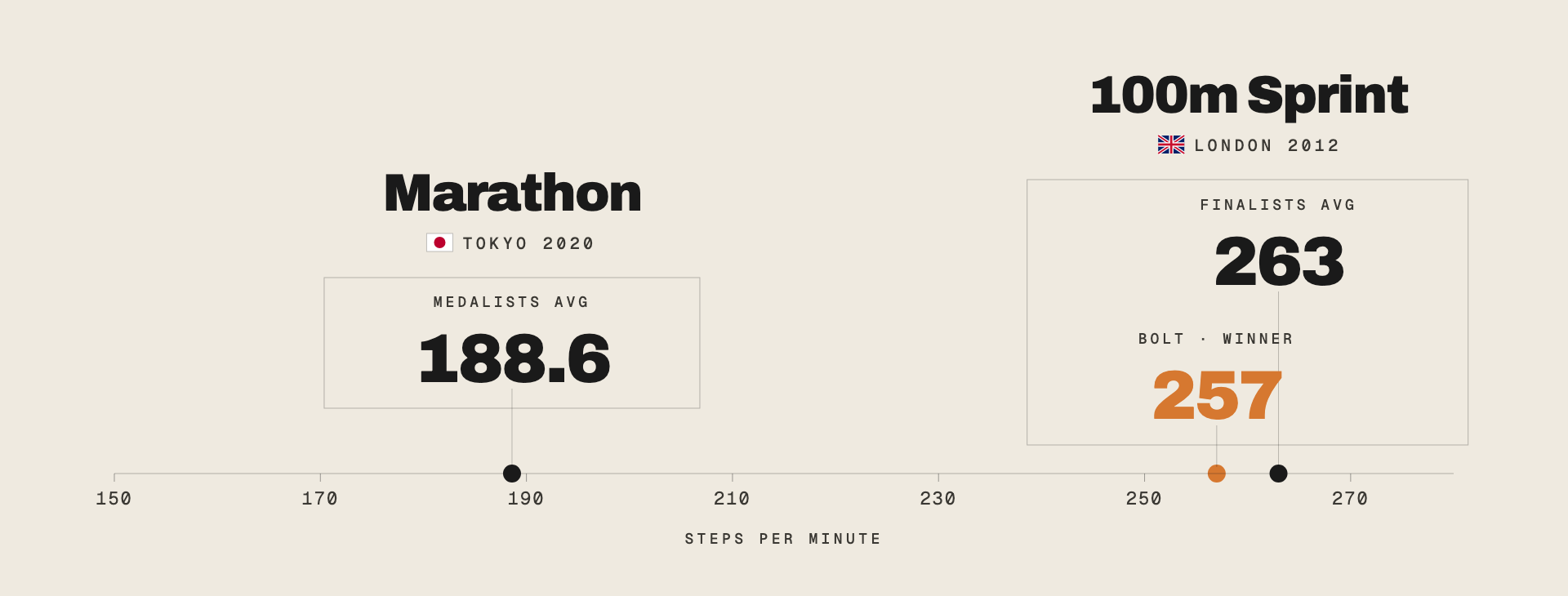
Diagram comparing running cadence (steps per minute) across two Olympic events: Tokyo 2020 marathon medalists averaged 188.6 SPM; at the London 2012 100 m sprint final, finalists averaged 263 SPM while gold medalist Usain Bolt ran at 257 SPM, below the field average.
What influences running cadence?
The highest possible cadence is not necessarily the best cadence.
Influence 1: Cadence increases with pace
Even among experienced recreational runners, cadence tends to rise as speed increases. In one treadmill study, runners increased from approximately 169 SPM at 2.68 m/s to 178 SPM at 3.83 m/s (Leacox et al., 2025).
Cadence across pace
Study details
Participants: 30 experienced runners (11 female, 19 male), aged 21–49. All participants had been running at least 24 km (15 miles) per week for the previous year and had no running-related injuries in the prior three months.
Protocol: Participants ran at seven controlled treadmill speeds ranging from 2.68 m/s to 3.83 m/s. Researchers measured cadence and running kinetics, including ground reaction forces.
Observed cadence:
- 2.68 m/s → ~169 SPM
- 3.16 m/s → ~172 SPM
- 3.83 m/s → ~178 SPM
Main finding: As running speed increased, runners tended to increase cadence.
Influence 2: Cadence decreases with runner height
Cadence is also influenced by body size. A study of trained runners found that taller runners tended to run with a lower stride frequency. The researchers reported that an increase in height of 10 cm was associated with a measurable decrease in stride frequency (Patoz et al., 2021).
Height was also strongly correlated with leg length, suggesting that runners with longer legs naturally adopt slightly lower cadence values.
Study details
Participants: 54 trained runners (21 female, 33 male) with recent race performances and no recent musculoskeletal injuries. Average height was 162 cm for women and 175 cm for men.
Protocol: Participants completed five 30-second treadmill runs at speeds ranging from 2.78 m/s to 5.00 m/s while researchers collected 3D motion data.
Measurement method: Seven infrared cameras tracked reflective markers placed on the shoes to identify footstrike and toe-off timing, allowing researchers to calculate stride frequency.
Main finding: Taller runners tended to run with a lower stride frequency. The analysis suggested that an increase in height of 10 cm corresponded to a decrease of approximately 0.054 Hz in stride frequency.
Possible explanation: Height was strongly correlated with leg length (r = 0.94), suggesting that runners with longer legs naturally adopt slightly lower cadence values.
Limitations: The study was performed on a treadmill, and a meaningful portion of cadence variation remained unexplained. Factors such as muscle strength, aerobic fitness, shoe characteristics, and outdoor running conditions were not fully captured.
What we still don't know
A significant portion of the differences between runners could not be explained by the model used in the study. This suggests that factors beyond height and speed also influence cadence.
We still do not fully understand how factors such as leg strength, aerobic fitness, footwear, fatigue, terrain, or footstrike mechanics interact with cadence. While cadence is often discussed as a single target number, current research suggests it is shaped by a combination of physiology, mechanics, and running context.
Why cadence matters
Researchers are interested in cadence because relatively small changes in step rate can alter running mechanics.
Multiple studies have reported that increasing cadence by around 5–10% above a runner's preferred cadence can lead to (Figueiredo et al., 2025):
- lower impact forces
- lower loading rates
- reduced knee stress
- changes in foot strike pattern
These biomechanical changes are one reason cadence modification is sometimes explored in injury prevention and rehabilitation.
However, this does not mean there is a single "ideal" cadence that all runners should target. The effects appear to depend on the individual runner, their mechanics, running speed, training background, fatigue, and the magnitude of the cadence change itself.
Study details
Study type: Systematic review examining how cadence changes influence running biomechanics and injury-related variables.
Main observation: Across multiple studies, increasing cadence by approximately 5–10% above preferred cadence was associated with biomechanical changes that may reduce mechanical stress on the body.
Reported biomechanical changes:
- lower impact forces
- lower loading rates
- reduced knee joint stress
- altered foot strike patterns
Important limitation: The review summarized findings from multiple studies using different protocols, runner populations, and measurement methods. The magnitude and consistency of the effects varied across studies.
How to improve your cadence?
Research suggests runners naturally synchronize movement timing with rhythmic sounds (see here). But a beat that helps on a steady run can fall apart the moment the effort changes, which is why a normal playlist often works against you during interval workouts.
Unanswered questions
Q.01
Yes, we can train cadence with auditory cues.
but does the effect last long term?
Q.02
Yes, higher cadence reduces impact forces.
but does it reduce injury risk?
Q.03
Yes, height affects cadence.
but what are the other factors?
Q.04
Yes, cadence tends to increase with pace.
but what should the ideal cadence-to-pace curve look like for each runner?
Reader poll
0 votes
Cadence is not a fixed number. It is a moving interaction between physiology, mechanics, speed, fatigue, and rhythm.